


By James Singh
Advanced Nurse Practitioner and Nurse Prescriber
The observations are not dramatic. The patient is talking. Nothing on the screen demands a blue-light response. Yet when you look at them, something is wrong. This is one of the hardest decisions in primary care. A textbook emergency gives us a clear route. The greater challenge is the person with vague symptoms, almost reassuring numbers and a change that is obvious only when we step back and take in the whole picture.
During one period of my career, while providing primary care in a children’s prison, I encountered this tension in a particularly sharp form. Sending a young person to hospital could require security arrangements, escort staff, safeguarding decisions and complicated transfer logistics. Those pressures were real, but they could not become the clinical threshold. I still had to ask: what is the risk of waiting if my concern is right?
The setting may be different, but the dilemma is familiar across primary care. We make decisions with incomplete information, limited time and services that are already under pressure.

The phrase ‘they just don’t look right’ can sound vague. It is not a diagnosis, but it is valuable information. A normally lively child who is unusually quiet, an older person who has become confused or stopped managing ordinary tasks, or an adult whose breathing, colour, speech or behaviour does not fit the history may all be showing early deterioration. As AI tools become more common in healthcare, I think this matters more, not less. Software can analyse the information we enter, but it cannot act on a change that nobody has noticed or recorded. Our eyes, ears and knowledge of the person still matter.
NHS England’s PIER approach brings together vital signs, recognised soft signs, staff concern and the concerns of patients, families and carers. Clinical instinct should not overrule the evidence. It should prompt us to gather more evidence when the picture does not fit.
A recent paediatric study gives a striking example. In a 2025 prospective cohort study, documented caregiver concern about deterioration was associated with intensive care admission and mechanical ventilation, even after adjustment for abnormal vital signs. This was hospital-based research in children, so it cannot simply be transferred to every primary care patient. The broader lesson is relevant at any age: someone who knows the patient well may recognise a significant change before the observations declare it.

Clinical observations are essential, but they are a snapshot. A normal temperature, oxygen saturation, pulse or blood pressure cannot cancel the history, the examination or a credible concern about change. Trends, baseline physiology, comorbidities, medicines, age and the wider clinical picture all matter.
NEWS2 gives us a standardised way to describe acute illness severity in adults in the settings for which it is intended. The Royal College of Physicians says it should supplement clinical judgement rather than replace it. Current NICE sepsis guidance also requires NEWS2 to be interpreted in context and recognises that a score of zero can coexist with clinical concern. Children need age-appropriate assessment and escalation tools.
When the patient and the numbers tell different stories, I pause, reassess and repeat the observations where appropriate. I look for change and involve someone else if the concern remains.
During my time working in emergency care, I saw adults who appeared physiologically stable for a time before deteriorating rapidly. It reinforced that deterioration is often a trajectory rather than a single abnormal reading. Reassessment matters when the wider clinical picture remains concerning.

We cannot discuss deterioration honestly without acknowledging the conditions in which primary care works: full appointment lists, rising demand, limited same-day capacity, ambulance delays and crowded urgent care services. NHS England’s primary care patient safety strategy recognises the particular risks across general practice, community pharmacy, dentistry and optometry, including access, continuity and the movement of information between services.
Pressure can quietly alter a decision. We may delay asking for a review because the duty clinician is overwhelmed. We may convince ourselves that a patient can wait because transfer will be difficult. Sometimes we give safety-netting when what we really believe is that the patient needs assessment now.
Resource constraints form part of the situation, but they do not reassure me about the patient. If the safest plan is difficult to achieve, that difficulty may itself need escalation. A system problem should not be disguised as a clinical decision.

One barrier to escalation is the thought, ‘I should be able to deal with this.’ It may come from professional pride, fear of appearing inexperienced, or reluctance to bother a busy colleague. A dismissive response in the past can make the next concern much harder to voice.
Safe practice is not solitary practice. The NMC Code requires nurses to make timely referrals and ask for help when something is beyond their competence. Experience does not remove the need for a second opinion, particularly when the presentation is ambiguous or delay could cause serious harm.
How colleagues and leaders respond matters. NHS England describes a supportive patient-safety culture as one in which people can raise concerns without fear of blame, reprimand or intimidation. If someone says, ‘I am worried, although I cannot yet explain why,’ the first response should be curiosity.

‘They just don’t look right’ is a useful trigger, but the handover needs to be specific. I use four clear statements:

Clinical decisions should be driven by the patient, not fear of litigation. Even so, missed deterioration can lead to avoidable harm, complaints, incident investigation, professional scrutiny and legal action. The answer is not to refer everybody. It is to follow a clear and proportionate process and record the reasoning behind it.
CQC Regulation 12 requires registered providers to assess risks to people’s health and safety and do what is reasonably practicable to reduce them. Individual clinicians also remain accountable for assessment, timely escalation, working within their competence and keeping clear records. If the decision is reviewed later, the record should show what information was available, what caused concern, whose advice was sought, what action followed and what the patient or carer understood.
A detailed entry cannot make an unsafe decision safe. It can support continuity and show how the decision was reached. I would record:

When the picture does not fit, I find these questions useful:

The first person to recognise deterioration may not be the most senior clinician. It might be a receptionist who notices that a familiar caller sounds confused, a healthcare assistant who finds an unexpected observation, a pharmacist who sees someone struggling to breathe at the counter, or a carer who says, ‘This is not how they normally are.’ Every member of the team needs a clear route for raising concern and confidence that somebody will listen.
The patient who ‘just doesn’t look right’ needs us to use all the evidence available: physiology, baseline, behaviour, professional judgement and the observations of people who know them. In a pressured service, the safest decision may also be the most inconvenient one. We still have to be prepared to make it.
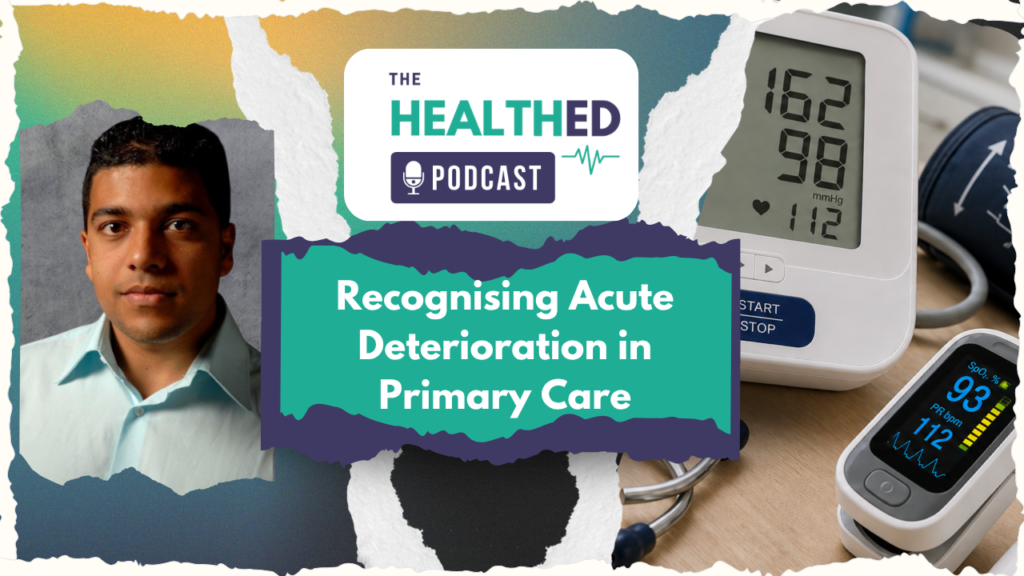
Join the live Health Academy lunchtime session The Patient Who Just Doesn’t Look Right: Recognising Acute Deterioration in Primary Care on Friday 6 November 2026, 12:30-13:30 GMT. Through short cases involving a child, an adult and an older or frail patient, we will explore when to manage, when to seek urgent review and when to call 999.

Our ‘Recognising the Unwell Patient’ course is ideal for both clinical healthcare support workers (HCSWs) and non-clinical reception staff in GP Practices. Covering ABCDE assessment, triage, red flag signs and sepsis, participants will gain crucial skills in identifying deteriorating patients to be able to facilitate timely care and referrals.
Sold Out

Our ‘Understanding Blood Results’ course covers the main blood tests offered in primary care. Combining theory with case studies to provide an overview and understanding of the routine haematology, biochemistry and other commonly requested blood results in order to recognise abnormalities at an early stage