


A fertility conversation can begin in the most ordinary of primary care consultations. A patient attending for cervical screening, a medication review or another routine appointment may mention that they have been trying to conceive without success. Others may simply be starting to think about pregnancy and want to know what they should consider first.
For patients, these conversations can come after months of worry and uncertainty. For healthcare professionals, particularly those who do not regularly work in fertility care, they can raise important questions: What should I ask? Are there any investigations I can start? Is there anything in the patient’s history I should be concerned about? When should this patient be referred?
Fertility is a specialist area, but primary care has an important role in that first conversation. Practice nurses, GPs and other primary care healthcare professionals are therefore in a valuable position to provide good preconception advice, recognise when something may need further investigation and help patients access specialist care at the right time.

Some of the most useful fertility conversations happen before a patient has experienced any difficulty conceiving.
We spend a great deal of time educating people about preventing pregnancy, but considerably less time talking about fertility itself. Many people reach the point of wanting to start a family without a particularly clear understanding of their menstrual cycle, when conception is most likely or how their general health may affect pregnancy and fertility.
A preconception consultation is a good opportunity to look at the wider picture.
This might include discussing:
Menstrual cycle regularity is important, as is understanding the couple’s circumstances and the health of both partners. Preconception advice should also include folic acid supplementation, in line with current guidance.
For couples trying to conceive naturally, current NICE guidance NG257: Fertility problems: assessment and treatment advises regular intercourse every two to three days to optimise the chance of pregnancy.
Where rubella vaccination history is uncertain, it may also be appropriate to check rubella status and offer vaccination if required, with advice to avoid pregnancy for at least one month following vaccination.
These may sound like relatively simple conversations, but they can make a real difference. They can also identify factors that warrant further assessment sooner rather than later.

One area where our understanding of fertility care continues to develop is male fertility.
Historically, fertility investigations have often centred heavily on the female partner. Yet male factors are an important part of fertility assessment, and both partners should be considered from the outset where appropriate.
When taking a fertility history, relevant questions for the male partner might include:
Semen analysis is also an important part of the initial assessment of possible male factor fertility problems.
Arranging a semen analysis may be relatively straightforward in primary care. However, receiving an abnormal result and explaining its significance to an understandably anxious patient can feel rather different.
An abnormal semen analysis does not necessarily provide a definitive answer. Repeat testing is usually recommended to confirm an abnormal result, with the timing guided by:
This is where knowing your local fertility pathway and where to seek further advice is invaluable. Primary care professionals do not need to become specialists in semen analysis, but it helps to understand what the next step should be.
For further information on male fertility and semen analysis, clinicians can refer to NICE NG257 and the Royal College of Nursing’s resources on male fertility, alongside their local fertility referral pathway.

Age can be a difficult fertility conversation to have, but it is an important one.
There is still a gap between public perception and the biological reality of fertility. Stories of people becoming pregnant in their late 30s or 40s are common, but patients may not know whether assisted conception, donor eggs or other fertility treatment played a part.
Female fertility declines with age, and that has implications for how quickly patients should be assessed and referred.
For people under 36 with no known or suspected cause of infertility, current NICE guidance recommends further clinical assessment and investigation if pregnancy has not occurred after one year of regular unprotected intercourse. This may include:
Specialist referral should be offered at presentation where the person trying to become pregnant is aged 36 or over, or where either partner has a known or suspected clinical cause of infertility or a history of factors that may predispose them to fertility problems.
So, while a period of trying to conceive before further investigation is appropriate for many younger patients, it is important not to apply the same timeframe to everyone.
These conversations need to be handled sensitively. Giving honest information about age and fertility is not about frightening patients; it is about giving them the information they need while there is still time to consider their options.

The length of time someone has been trying to conceive is only part of the picture. Sometimes the history gives us clues that there may already be an underlying reason why conception is proving difficult.
For women and people with female reproductive organs, conditions and factors to consider include:
None of these conditions automatically means that someone will be unable to conceive. Many people with endometriosis or PMOS, for example, may become pregnant without fertility treatment. However, a known or suspected cause of infertility should change the way we think about timing.
Current NICE guidance recommends specialist referral at presentation where either partner has a known or suspected clinical cause of infertility or a history of factors that may predispose them to fertility problems.
This is why a good history is so valuable. Before ordering a long list of fertility tests, consider whether there is already something in the patient’s menstrual, reproductive, gynaecological, medical or surgical history that suggests they may need earlier assessment.

What can be initiated before referral will depend on the patient’s individual circumstances, local services, referral pathways and the clinician’s role.
A good history should always come first.
For women and others with female reproductive organs, asking about the frequency and regularity of menstrual cycles can provide useful information about whether ovulation is likely to be occurring. If cycles are regular and monthly, ovulation is likely.
Initial investigations may include:
For the male partner, initial assessment may include:
The aim is not to complete every possible investigation before referral. Instead, it is to start the appropriate assessment, identify anything that may alter the pathway and make sure specialist input is sought when needed.

A fertility assessment should not become a checklist of investigations.
Work, lifestyle, relationships and the practical realities of someone’s life can all be relevant.
A couple may understand when conception is most likely, but certain circumstances may make trying to conceive more challenging in practice such as:
Smoking is another important factor. It is likely to reduce fertility in women and is associated with reduced semen quality in men. Weight can also be relevant: a higher BMI is associated with reduced fertility, while low body weight can affect ovulation in some women.
These conversations are an opportunity to identify factors that may be influencing fertility and to offer practical, evidence-based advice where appropriate. Even relatively small changes may help optimise general health and reproductive health while investigations or referral are underway.

Patients sometimes arrive at the consultation with the assumption that difficulty conceiving will eventually mean IVF. In reality, fertility care is much more individual than that.
The treatment offered will depend on the underlying issue, and IVF is only one of a number of possible approaches. It can be an enormously important treatment for some patients, but it does not overcome every cause of infertility or remove the effect of age on reproductive potential.
Access to fertility treatment can also be an important part of the conversation. Key points to be aware of include:
For anyone considering private treatment, the Human Fertilisation and Embryology Authority (HFEA) is a useful source of impartial information. It regulates UK fertility clinics and provides information to help patients understand fertility treatments and compare licensed clinics.

Perhaps one of the most important parts of fertility care has nothing to do with investigations.
Fertility difficulties can affect almost every aspect of someone’s life. Patients may spend months or years navigating:
Importantly, these experiences do not necessarily end when fertility treatment or specialist care ends. Patients may return to primary care months or even years later for something entirely unrelated, while still carrying a significant emotional impact from what they have been through.
NICE recognises this and recommends that counselling is offered before, during and after fertility investigation and treatment, irrespective of the outcome.
Primary care professionals have an important role here too. We may not be providing specialist fertility counselling, but we can listen, acknowledge what someone has been through and make sure they know where further support is available.
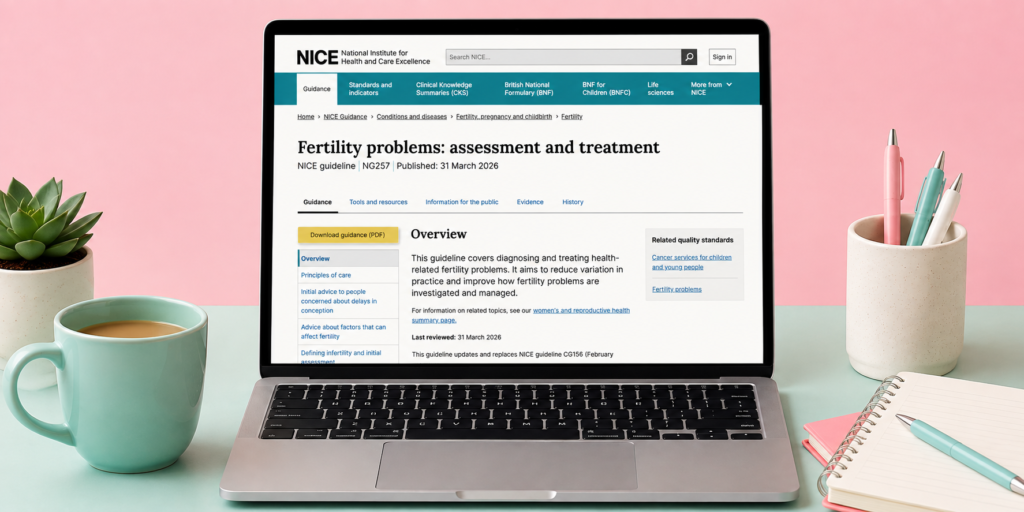
Fertility is an area where patients can very quickly find themselves overwhelmed by information.
A few minutes of research online can lead to supplements, tests, specialist diets, alternative therapies, private treatments, social media accounts and countless personal stories. Some of it will be useful. Some will have little evidence behind it. Some may be commercially driven.
It is particularly difficult to judge the quality of that information when you are already anxious and desperate to find something that might help.
We do not need to know the answer to every fertility question ourselves, but we can give patients reliable places to start.
Useful sources for both patients and healthcare professionals include:
Clinicians should also be familiar with their local NHS fertility services, referral pathways and funding criteria, as these can vary across the UK.
Sometimes good fertility care in primary care is simply recognising the concern, asking the right questions and helping the patient find the right next step.

Fertility can be a complex area, particularly when it is not something you encounter every day in practice. Knowing what to ask, what can reasonably be investigated in primary care and when specialist input may be needed can help make these conversations easier for both clinicians and patients.
We recently explored these issues in our Fertility Care in Primary Care Lunchtime Health News session, where women’s health and fertility nurse consultant and educator Kate Pleace joined Clinical Trainer Alys Bunce for an informal discussion about fertility care in everyday primary care.
The conversation covered preconception health, initial assessment and investigations, male fertility, age, referral and treatment pathways, and the emotional impact of fertility difficulties.
The 45-minute session, recorded live in July 2026, is available to watch free on demand below.
For anyone who would like a broader introduction to the subject, our 1 day Fertility Care in Primary Care course also looks in more detail at supporting patients who present with fertility-related questions.
Click below to find out more and register your interest, or contact us if you would like to arrange a bespoke session for your team.

Our ‘Fertility Care in Primary Care’ course supports healthcare professionals with pre-conception advice, fertility assessment, investigations and referral pathways.
Sold Out